

THE EXTERNAL NOSE
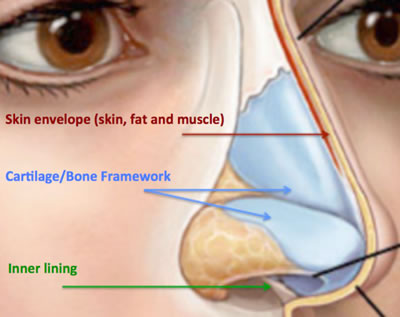
The nose consists of three layers, from the outside in. The nasal root is the anatomical starting point of the nose, where it attaches to the forehead, and serves as a key landmark in nasal and craniofacial anatomy. The skin over the nose has different thicknesses. It is thin over the bridge of the nose, but thicker over the lower third of the nose. Beneath the skin, the soft tissue layers, including fat, muscle, and connective tissue, play a significant role in nasal aesthetics and function. The deep fatty layer, located just beneath the skin and fibromuscular layer, is an important anatomical plane containing major superficial blood vessels and nerves, and is relevant in surgical procedures.
The skin can be thought of as paint that covers the house. If the covering is thick, the underlying structures (cartilage and bone) will be less pronounced. With a thin coating, the underlying structures are clearly visible, and small irregularities can be visible to the eye. Individual differences in skin thickness, nose shape, and the way the nose varies among people are influenced by variations in bone, cartilage, and soft tissue.
Understanding external nasal anatomy is crucial for assessing nasal features, symmetry, and proportions, and is especially important in surgical planning and achieving facial harmony.
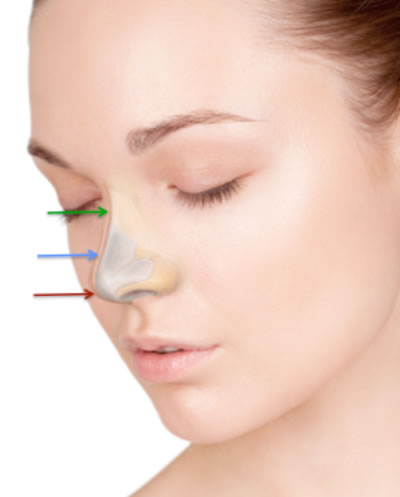
NASAL CARTILAGE AND NASAL BONES STRUCTURE
Green arrow > bones of the maxilla (zygomatic bone) and nasal bones
Blue arrow > septum attached to the upper lateral cartilage
Red arrow > lower lateral cartilage
The nose is supported by the bone and cartilage structure. The nasal skeleton forms the fundamental support framework of the nose. The upper part of the nose is supported by the paired nasal bones, which connect to the frontal bone, as well as the bones of the upper jaw (maxillary bone).
The middle third of the nose is supported by the septum, which includes the septal cartilage, attached to the upper lateral cartilage. These cartilages support the middle part of the nose. The dorsal septum and nasal dorsum provide additional support and shape to the bridge of the nose, playing a crucial role in nasal stability and aesthetics. Loss of this support can lead to a saddle nose, a deformity in which the bridge of the nose has collapsed, or, in some cases, to a septal perforation.
The lower third of the nose is supported by the major alar cartilage, which forms the nostrils and supports the nasal tip. These cartilages are curved and angle outward to give the characteristic shape to the tip and part of the sides of the nostrils (alar).
NASAL CAVITY
The nasal cavity is a central feature of the human nose, forming a spacious, air-filled chamber within the skull. Divided into two symmetrical passages by the nasal septum, the nasal cavity serves as the main route for air entering the upper respiratory tract. Each side of the nasal cavity is lined with a specialized mucous membrane that works to warm, humidify, and filter the air before it reaches the lungs. Deep within the nasal cavity lies the olfactory epithelium, a region packed with olfactory cells responsible for detecting scents and sending signals to the brain, giving us our sense of smell. The nasal cavity is not only essential for breathing but also plays a vital role in protecting the respiratory system from airborne particles and pathogens.
NASAL SEPTUM
The nasal septum is the internal wall that divides the nasal cavity into left and right passages. Structurally, it is made up of a front portion of cartilage and a rear portion formed by the plate of the ethmoid bone. This combination of cartilage and bone provides crucial support to the nose, helping to maintain its shape and direct airflow efficiently through the nasal passages. When the nasal septum is deviated or develops a perforation, it can lead to nasal obstruction, making breathing difficult and sometimes causing chronic nasal congestion. Proper alignment of the nasal septum is essential for optimal airflow and overall nasal function.
SINUSES
Surrounding the nasal cavity are the paranasal sinuses, air-filled spaces within the bones of the skull. There are four pairs of sinuses: frontal, maxillary, ethmoid, and sphenoid. These sinuses are connected to the nasal cavity and lined with mucous membranes that produce mucus to keep the nasal passages moist and trap unwanted particles. In addition to their role in humidifying and filtering the air, the paranasal sinuses help to lighten the weight of the skull and contribute to the resonance of the voice. When the sinuses become inflamed, a condition known as sinusitis, it can lead to symptoms such as nasal congestion, facial pain, and a runny nose, affecting both breathing and comfort.
INSIDE THE NASAL CAVITY
The internal nose contains several important internal structures, including the mucous membrane, septum, and turbinates, which play key roles in nasal function and protection. The nasal musculature is responsible for nasal movement and contributes to facial expression. The nerve supply to the internal nose is complex, involving the maxillary nerve, ophthalmic nerve, anterior ethmoidal nerve, external nasal nerve, and nasociliary nerve, all of which provide sensation to different regions of the nose.
The inner layer of the nose is made up of skin and mucous membrane. It is a vital layer of the nose. Any deficiencies (cracks or holes) allow bacteria normally carried in the nose to infect the middle structure of the nose and can cause damage to the cartilage of the nose and weaken its supporting structure.
FREQUENTLY ASKED QUESTIONS ABOUT NOSE ANATOMY
What are the main structures of the nose involved in reconstruction?
How does nasal cartilage affect the shape and support of the nose?
What is nasal reconstruction surgery and who needs it?
What causes deformities of the nose that require reconstruction?
What is a saddle nose deformity and how is it treated?
How long does it take to recover from nasal reconstruction surgery?
Will nasal reconstruction improve breathing as well as appearance?
Can different parts of the nose be reconstructed separately?
Why is using a patient’s own cartilage preferred over synthetic implants?
What should I ask my surgeon before nasal reconstruction?
MAKE AN APPOINTMENT?
LEAVE YOUR NUMBER, AND WE WILL CALL YOU BACK