

We perform nose reconstruction following (nasal) nose collapse from vasculitis such as Wegener’s (Granulomatosis with Polyangiitis (GPA) or other rheumatological conditions.
The first important point to make is any intervention must be made in conjunction with your Consultant Rheumatologist. Surgical intervention is timed for a period of inactivity ‘remission’ or when the disease process has gone into long-term remission ‘burnt out’.
Inflammation of the Blood Cells in the Nose
The vasculitis such as Wegener’s or otherwise known as Granulomatosis with Polyangiitis (GPA) causes an inflammation of the small and medium sized blood vessels. In the nose this causes inflammation in the muscosa. This results in a cycle of inflammation and healing with granulation (healing) tissue and that results in scarring. This process can be modified by the bacteria you contain within your nose amplifying this process.
Symptoms and Signs of Active Vasculitis
As this process continues there is often a stepwise progressive injury to the nose; mucosal bleeding, nasal stuffiness and crusting in the nose and occasionally nasal pain. Other systemic symptoms may include weight loss, shortness of breath, coughing up blood, blood clots, and skin rash if the lungs and kidneys or other organs are affected. These are all signs of disease activity and should initiate a medical review from your Rheumatologist. Endoscopic examination of your nose and white blood cell test, such as cANCA, PR3, and MPO, all of which are useful in monitoring disease activity.
How Saddle Nose Deformity Develops
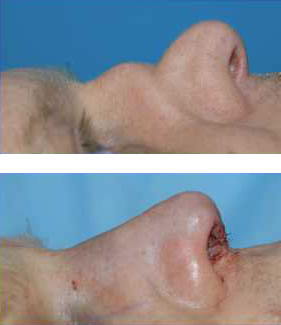
As the cycle of inflammation and healing continues the cartilage in the septum is weakened secondarily to the inflammatory process. This can lead to a septal perforation (hole). As this perforation (hole) enlarges it can in some instances cause weakening of the support of the middle portion of the nose and can result in a saddle nose deformity in your nose.
If the septum is progressively damaged the saddle nose deformity worsens and the nose can become shortened and the tip of the nose rotates upwards.
Severe Damage to the Nose and Affected Blood Vessels
With further damage from a cycle of inflammation and healing, the inner lining of the nose begins to shrink through scarring and further shortening of the nose occurs.
The end result is a shortened upturned nose with deficiencies in the inner lining of the nose and cartilage framework. Please note only a small proportion of vasculitic patients develop saddle nose deformity.
In a very small minority of patients this inflammation can extend full thickness (all three layers of the nose) and results in a hole (fistula) between the skin and the nose (nasal cavity). These patients will then have deficiencies in all three layers of the nose (skin, cartilage, lining).
Nose Reconstruction for Vasculitis Patients
The type of reconstruction will change depending on the severity of the deformity for correction of Saddle Nose Deformity to Moderate Nose Reconstruction to Major Facial And (Nasal) Nose Reconstruction. But these deformities can be repaired when the patient is in remission.
See our article for Vasculitis.org.uk
Nose Vasculitis FAQs
What is vasculitis of the nose, and how does it affect nasal structure and function?
What are the common symptoms or signs that someone may need nasal reconstruction due to vasculitis?
How is a diagnosis of nasal vasculitis confirmed before considering surgery?
At what stage in vasculitis treatment is nasal reconstruction typically recommended?
What types of nasal deformities are commonly treated in vasculitis patients?
What surgical techniques are used to reconstruct the nose after vasculitis-related damage?
Is cartilage grafting always necessary for reconstruction in vasculitis cases?
How long is the recovery period following nasal reconstruction for vasculitis?
Will I need more than one surgery to achieve full correction?
How does ongoing vasculitis or autoimmune disease management impact surgical outcomes?
EXECUTIVE DOCTOR
CALLUM FARIS
ENT specialist and specialist in facial plastic surgery